
Behind the Scenes: How I Handle Conflicting Stakeholder Priorities Without Losing My Mind
A field-tested playbook for Scrum Masters and change agents dealing with messy stakeholder realities.

It was early 2024.
I was coaching three Scrum Teams across different business units of a fintech client — Payments, Growth, and Customer Support.
The quarterly OKRs looked perfect on paper:
Payments: Reduce transaction failures by 20%
Growth: Launch referral program in 6 markets
Support: Bring down response time to under 2 minutes
But in Sprint Planning, everything went sideways.
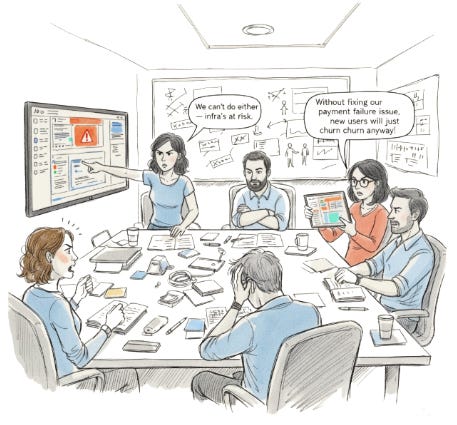
Each Product Owner came in armed with Jira dashboards, showing why their backlog items were most urgent.
One team lead said, “If we don’t ship referral tracking now, Marketing will miss their campaign window.”
Another said, “Without fixing our payment failure issue, new users will just churn anyway.”
Meanwhile, the Arch Manager quietly added, “We can’t do either — infra’s at risk.”
I remember sitting in that room thinking — this wasn’t misalignment; it was a survival game masked as prioritization.
That moment taught me something powerful:
True alignment doesn’t come from more meetings — it comes from shared evidence.
When multiple teams and stakeholders pull in different directions, you can’t solve it through authority.
You solve it through visibility, shared data, and guided dialogue.
Here’s how I handled it — step by step.
Strategy-01: Create a Shared “North Star” Conversation
Action Plan:
Invite the right mix — all Product Owners, and stakeholders.
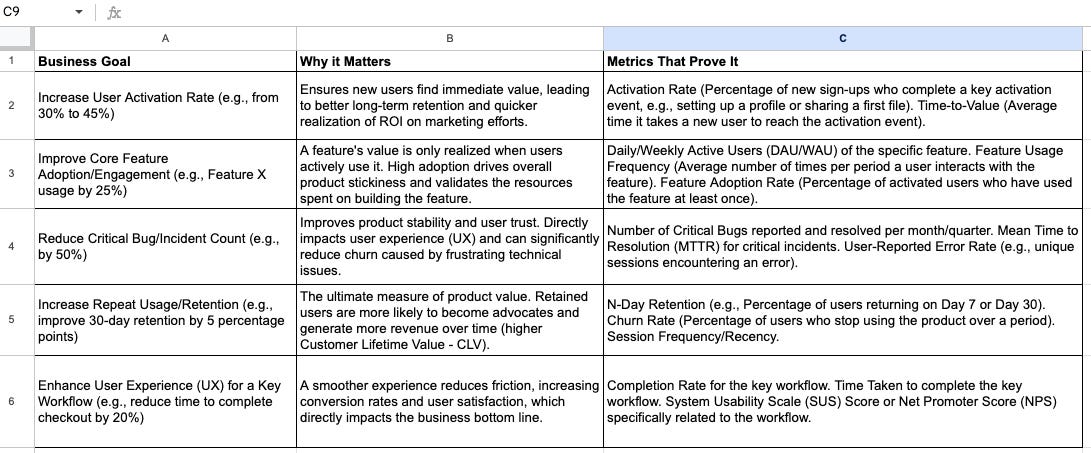
On a Miro board, create 3 columns: “Business Goal,” “Why it Matters,” “Metrics That Prove It.”
Ask everyone to write their top 2 goals individually using sticky notes.
Cluster similar goals. You’ll notice overlap that wasn’t visible before.
End by asking: “If we could only achieve one of these outcomes this quarter, which one would make everything else easier?”
Convert that into a quarterly “North Star” goal (e.g., “Increase successful transactions by 15%”).
Challenge I Faced
Initially, every stakeholder came to the meeting defensive.
Marketing wanted “growth,” Payments wanted “stability,” and neither cared about the other’s KPIs.
They saw alignment as a negotiation game, not a shared vision.
I started with data, not opinions.
I showed them a retention funnel chart — how 62% of users dropped off during payment.
Suddenly, everyone leaned forward.
Once I grounded the discussion in customer impact, not team interests, the tone changed.
We ended the meeting with a statement everyone agreed on: “Let’s stabilize before we scale.”
Strategy-02: Use an “Impact vs Effort” Matrix for Objective Debates
Action Plan:
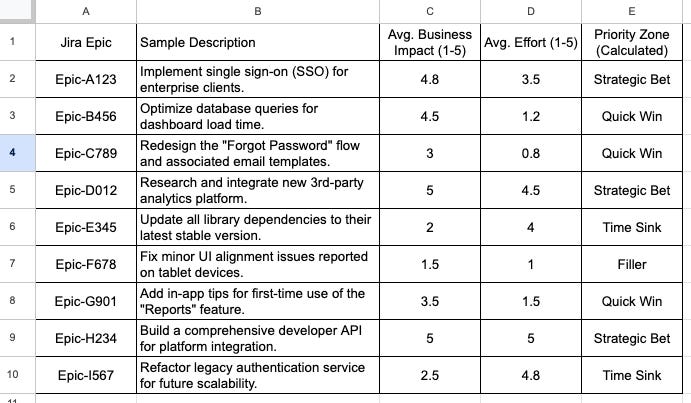
Export all initiatives from each Jira board (use filters by Epic).
Create a shared Impact vs Effort Matrix in Excel or Miro.
Ask each Product Owner to estimate “Business Impact” (1–5) and “Effort” (1–5) — but not for their own items.
Average out the team’s votes.
Sort items into 4 zones:
Quick Wins (High Impact, Low Effort)
Strategic Bets (High Impact, High Effort)
Fillers (Low Impact, Low Effort)
Time Sinks (Low Impact, High Effort)
Challenge I Faced
Every team rated their items higher — obvious bias.
At one point, the Growth PO joked, “Of course we think our feature is more impactful — we’re Growth!”
I introduced a small rule: “No one rates their own initiatives.”
It felt uncomfortable initially, but it created a safe distance between ego and evidence.
By the end, people started defending others’ initiatives instead of their own.
The conversation turned from personal agenda to portfolio thinking.
Strategy-03: Build a “Priority Ladder” in Jira
Action Plan:
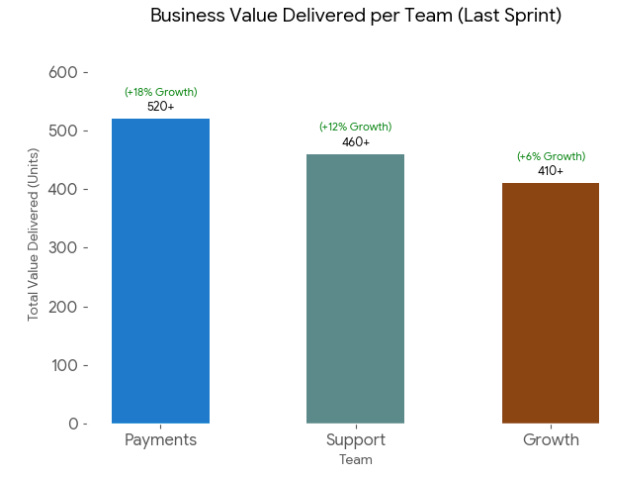
In Jira, create a custom field: “Business Value (1–100).”
Ask each stakeholder group to assign a value collaboratively — supported by metrics like:
Customer reach (# of users impacted)
Revenue potential (₹ value)
Technical risk reduction score
Sort backlog items in descending order of Business Value.
Use the Jira Dashboard Gadget to visualize total value per team.
Challenge I Faced
Stakeholders frequently changed their priorities mid-Sprint.
One director would message the PO directly: “Hey, please bump this story up — leadership wants it in next release.”
It created chaos and frustration for the teams.
I proposed a “Priority Freeze Window.”
We agreed: “Priorities can change during Sprint Reviews, but once the Sprint starts, backlog stays locked.”
I backed this up with Jira data showing:
Average context-switching dropped from 3 to 1.
Sprint completion rate rose from 74% → 92%.
That evidence made it stick.
Strategy-04: Facilitate “Priority Reflection Retros”
Action Plan:
During the last 10 minutes of Sprint Retro, add two simple questions:
“Which item delivered the most impact this Sprint?”
“Did we get distracted by anything that wasn’t priority?”
Use Confluence to track shifts in focus over time.
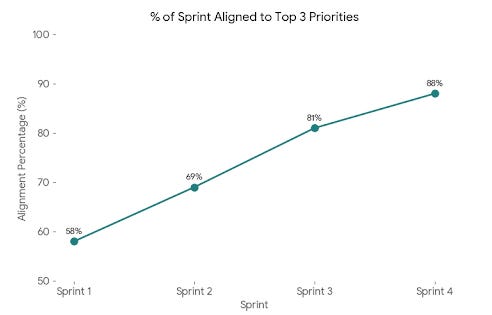
Create a simple trend chart showing “% of Sprint aligned to top 3 priorities.”
Challenge I Faced
Initially, people rolled their eyes.
“Not another retro topic,” someone muttered.
I showed them how these misalignments were hurting lead time — stories spent 2.7 days longer on average when priorities shifted mid-Sprint.
When people saw the data-cost of confusion, retros became sharper.
Teams started owning their prioritization decisions instead of waiting for “someone to tell them.”
Strategy-05: Implement the “One Voice” Protocol for Stakeholder Alignment
Action Plan:
For every initiative, assign a single Alignment Owner (e.g., Product Manager).
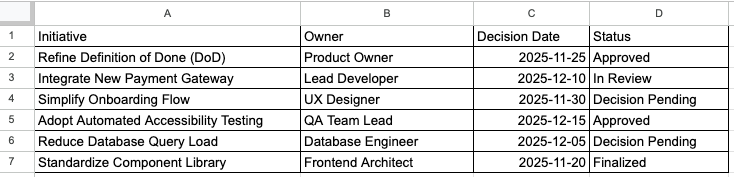
Document decisions in a shared Notion Decision Log — date, owner, next check-in.
All stakeholder input flows through that owner — no direct team interventions.
Review this log weekly in your Scrum of Scrums.
Challenge I Faced
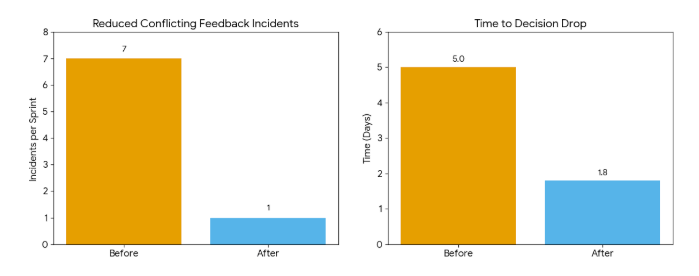
One senior VP kept bypassing the alignment owner and directly pinged developers on Teams.
The team felt pressured and confused.
Instead of escalating, I had a one-on-one with him.
I said gently: “When feedback comes directly to developers, it creates rework and confusion. Can we route it through [Owner Name] so we keep consistency?”
He agreed.
Because it wasn’t about authority — it was about protecting flow and clarity.
Reflection Challenge
Before your next Sprint Planning, ask:
“If every team delivered just one thing that would move our North Star by 10%, what would that be?”
You’ll be surprised how quickly that question cuts through chaos.
Join our Community — Practice It Live!
If you want to practice these techniques live, join my next AI & Agile Career Accelerator - Community of Practice.

🚀 Join us this Saturday. Practice real scenarios, get coached live, and build the confidence to lead your next refinement like a pro.
Ace Every Interview Question — With Real Answers That Work
If you’re preparing for Scrum Master, Agile Coach, or Product Owner interviews, this is your go-to prep pack. New set every week!
📥 Download your free Agile Interview Q&A Set here →
Why Subscribe
Each week, I share battle-tested strategies, messy lessons, and practical tools that help Scrum Masters, Product Owners, and change agents like you make sense of chaos — without sugar-coating it.
If you found this useful, subscribe.
This isn’t theory. It’s real work, made a little easier — one step at a time.
Thanks for reading Strategy For Success! Subscribe for free to receive new posts and support my work.
“Just because I understand it, does not mean everyone understands it. And just because I do not understand it, does not mean no one understands it.”

Anand Pandey
Thanks for reading Strategy For Success! Subscribe for free to receive new posts and support my work.