
From Invisible to Indispensable: The Remote Scrum Master’s Playbook
5 Proven Strategies to Get Recognized Without Sounding Like You’re Boasting

I once thought great facilitation speaks for itself.
Then remote work happened.
And suddenly… no one noticed the effort behind my role as a Scrum Master.

I was running Daily Scrums, helping unblock dependencies, supporting the Product Owner, and ensuring Sprint goals were intact.
But during a review, my manager casually said:
“I didn’t realize you’re driving all these events so smoothly.”
That felt a bit awkward - because the work was there — it was just invisible.
That’s when I realized: in remote work, visibility doesn’t happen naturally — it must be designed intentionally.
And it’s not about “showing off.”
It’s about showing alignment, outcomes, and leadership.
Here’s the exact playbook I’ve built over time — for Scrum Masters, Product Owners, and change agents who want their impact seen, not just assumed.
Strategy 1: Replace Status Updates with “Impact Statements”
It’s easy to say:
“I facilitated retrospectives and removed blockers.”
“I groomed backlog items and clarified requirements.”
But none of that shows impact — only activity.
Your Next Step:
Reframe every update around value created:
Instead of saying:
“I facilitated the retrospective.”
“I refined user stories.”
Say this:
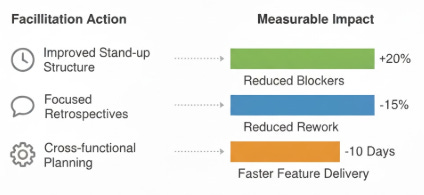
“I facilitated the retrospective where the team identified and fixed the QA bottleneck — saving us almost a full day per Sprint.”
“I clarified the user stories that reduced confusion during development and cut rework by 30%.”
Maintain a personal “Impact Log”:
Create a simple table in Excel:

Use this data in sprint demos or management syncs:

End your summary with: “Here’s how our last three sprints improved flow and predictability.”
Challenge I faced:
Initially, I felt awkward talking about “my” wins — especially when facilitation isn’t tangible.I started reframing the visibility as “making team success visible.”
I started pitching it as: “The team collectively improved lead time by 20%, thanks to changes we facilitated.”
Strategy 2: Visualize Your Progress — Don’t Let It Die in Jira
As a Scrum Master or PO, your impact often gets buried behind Product Backlog items.
Leaders see what was delivered — not how it happened.
Your Next Step:
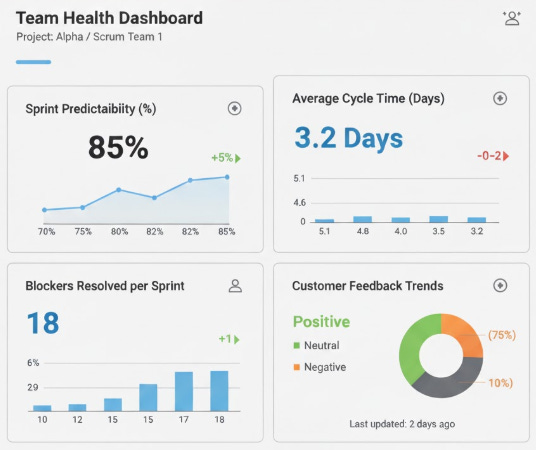
Create a Team Health Dashboard (in Jira or ADO):
Track metrics like:
Sprint predictability (%)
Average cycle time
Blockers resolved per Sprint
Customer feedback trends
Share patterns, not numbers:
In the Sprint Review, say:“Here’s what changed after we introduced Work-In-Progress limits — notice how blockers dropped by half.”
Record a short 2-minute Loom summary:
Walk through charts, highlight improvements, and tag stakeholders in Slack or Teams: “Quick summary of this Sprint’s progress — improved predictability by 18%.”

Challenge I faced:
One of my managers started using your dashboard to “monitor” instead of “understand.”So, I started setting context before sharing:
“This dashboard isn’t about control — it’s about learning what’s improving and where we can help the team next.”
Strategy 3: Build Connection Beyond Ceremonies
As a Scrum Master or PO, visibility also depends on relationships — especially when part of the team is remote.
If you only interact in Daily Scrums, you’ll be seen as a meeting host, not a leader.
Your Next Step:
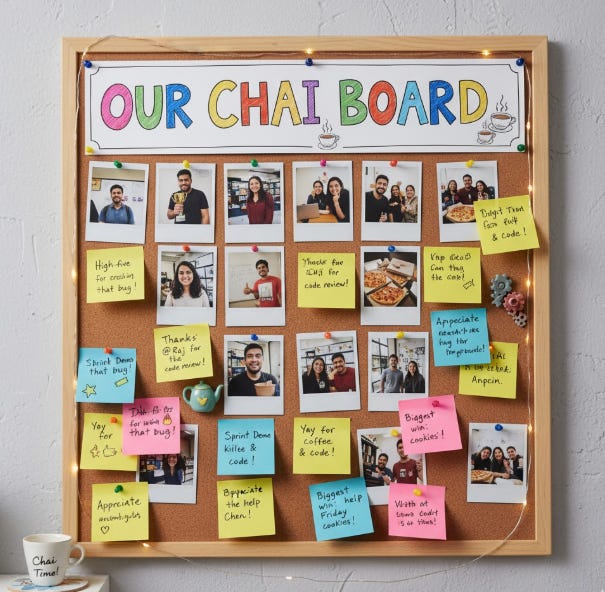
Host weekly 15-minute “Virtual Chai Circles”:
Pick informal prompts: “One small win this week,” or “What frustrated you most?”
Rotate facilitation.
Keep cameras on to humanize interactions.
Run “Behind-the-Scenes” posts:
In Slack or Teams, share one learning from your facilitation.
Example: “Tried the ‘Start-Stop-Continue’ format in retro today — got much richer feedback than usual.”
Spotlight others:
Mention developers or testers by name when sharing outcomes:
Example: “The team nailed Sprint Planning thanks to Priya’s clarity on story slicing.”
Challenge I faced:
Initially, remote members did not engage — cameras off, minimal talk, “just finish the meeting” attitude.
Then I started privately check in:“Hey, I sense you’re quieter lately — anything I can adjust in facilitation?”
Empathy creates participation — participation creates visibility.
Strategy 4: Use Retrospectives to Capture Your Coaching Impact
Retros aren’t just for the team — they’re proof of your influence as a facilitator or PO.
Your Next Step:
Add recognition-oriented retro prompts:
“What change helped us most in the last Sprint?”
“Which facilitation or clarification saved us time?”
Track recurring patterns:
Example: “Communication gaps” appear every Sprint → track how your interventions reduce frequency.
Summarize improvements monthly:
Create a “Continuous Improvement Tracker.”


Challenge I faced:
Team members rarely give feedback to the facilitator.
They assume retros are “their” space, not yours.At the end, ask:
“What about the way I facilitated today helped or hindered your participation?”
You’ll gain both feedback and credibility.
Strategy 5: Build a Personal “Visibility Engine”
Visibility for a Scrum Master or PO should be traceable across sprints.
You’re the keeper of flow and outcomes — build proof around that.
Your Next Step:
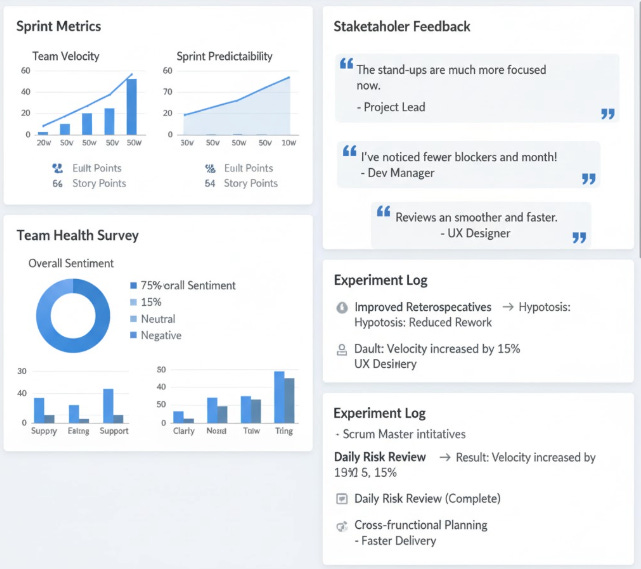
Create a Confluence “Impact Dashboard.”
Include sections:
Sprint metrics (velocity, predictability)
Stakeholder feedback snippets
Team health survey results
Experiment log
Update monthly:
Pull highlights from your retros, Jira reports, and Teams appreciation messages.
Keep visuals: “Before and After” graphs.
Share it quarterly:
Send a note before reviews: “Here’s a summary of how we improved team predictability and cross-team coordination in the last quarter.”
Use it in stakeholder syncs:
“Here’s how our last 3 Sprints reduced rework — and the next improvement we’re testing.”
Challenge I faced:
Some leaders won’t read long summaries. So, I started creating a a one-page visual summary — a graph or bullet dashboard.
The goal is recognition through clarity, not volume.
Reflection Challenge
Tomorrow, in your Daily Scrum or stakeholder sync, try this:
Instead of saying: “We’re on track with Sprint tasks.”
Say: “We’re on track, and the new refinement format has reduced confusion by 40%.”
Watch how that small shift commands attention.
You don’t need to speak louder.
You just need to speak clearly about the right things.
When your facilitation creates visible change,
your silence turns into influence.
👥 Join the CoP — Practice It Live
Want to experience how to make your facilitation and leadership visible without over-talking or overselling?
Join my Scrum Career Accelerator – Community of Practice.
We simulate real hybrid setups:
Cameras off, people disengaged.
Stakeholders asking tough questions.
You facilitating calmly, visibly, and confidently.
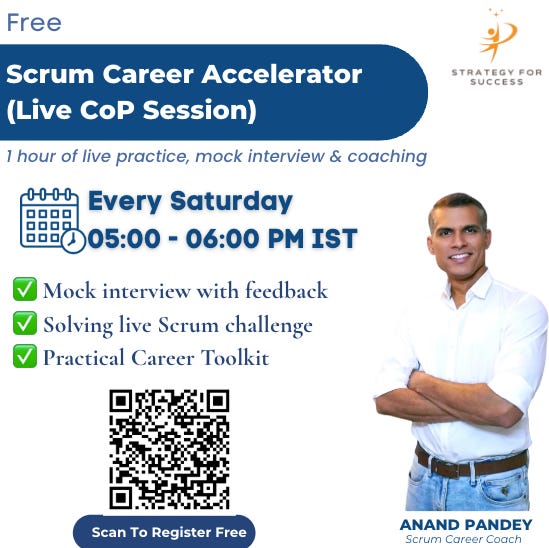
🚀 Join us this Saturday. Practice real scenarios, get coached live, and build the confidence to lead your next refinement like a pro.
Master Every Interview Question on Remote Scrum Mastery!
Ever found yourself in an interview (or even a performance review) struggling to articulate your impact as a Scrum Master when you’re largely remote?
Or, perhaps you’ve been asked:
“How do you ensure your contributions are visible when you’re not physically with the team or stakeholders?”
“What metrics or qualitative feedback do you use to demonstrate your value from a distance?”
Most Scrum Masters give safe, textbook answers like, “I facilitate ceremonies and remove blockers.”
But when the interviewer or your manager digs deeper — “Tell me a specific instance where your remote facilitation led to a measurable improvement for the team or product.” — they often hesitate.
Not because they don’t understand Agile, but because the subtle art of making your remote impact tangible and visible requires more than just showing up to virtual meetings. It requires intentional strategies and evidence.
That’s exactly why I’ve created a Practical Interview & Self-Assessment Guide on Remote Scrum Master Visibility & Impact — based on real strategies I’ve used and coached with Scrum Masters who successfully lead teams spread across locations, time zones, and often, varying levels of comfort with remote collaboration.
Inside this guide, you’ll find:
✅ 10 real interview questions about demonstrating visibility and impact as a remote Scrum Master.
✅ Story-style answers with practical examples, communication scripts, and visual evidence (like dashboard snippets or feedback examples) from actual remote and hybrid team scenarios.
✅ Actionable tactics to proactively track and showcase your influence on team predictability, stakeholder satisfaction, and overall flow.
This isn’t theory — it’s drawn straight from live remote challenges, virtual facilitation breakthroughs, and measurable outcomes that actually worked to elevate a Scrum Master’s perceived value.
If you’re preparing for a Scrum Master, Agile Coach, or Product Owner role, or simply want to better articulate your impact in your current remote/hybrid role, this is your go-to toolkit to show you can handle the strategic and visible side of remote agile leadership.
📥 Download your free Real Interview Q&A Set here →
Start preparing like professionals who’ve actually coached collaboration in hybrid teams — not just talked about it in slides.
📚 From My Shelf
📘 This Week’s Book: The Ultimate Coaching Guide by Vikram Dhar
(A must-read for anyone serious about unlocking human potential.)
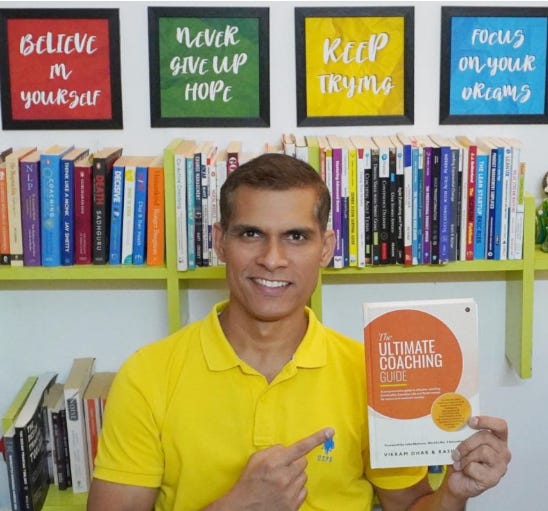
Vikram doesn’t talk about giving advice.
He talks about creating awareness, responsibility, and self-belief — the real levers of transformation.
The kind of coaching that empowers people to think, act, and grow beyond limits.
What influenced me most?
“The goal of coaching is not to teach, but to help others learn.”
For any Scrum Master or Product Owner guiding teams—this book is a masterclass in enabling ownership, not enforcing control.
Have you read it? What’s one coaching principle that changed your approach?
Why Subscribe
Each week, I share battle-tested strategies, messy lessons, and practical tools that help Scrum Masters, Product Owners, and change agents like you make sense of chaos — without sugar-coating it.
If you found this useful, subscribe.
This isn’t theory. It’s real work, made a little easier — one step at a time.
“Just because I understand it, does not mean everyone understands it. And just because I do not understand it, does not mean no one understands it.”

Anand Pandey
Thanks for reading Strategy For Success! Subscribe for free to receive new posts and support my work.