
How to Handle When Leadership Promises Dates Before the Team Even Estimates
How to Handle When Leadership Promises Dates Before the Team Even Estimates

It was a Tuesday morning when I got the email:
“We’ve committed to delivering the new Customer Portal Revamp by March 15.”

Except…
We hadn’t even estimated yet.
Half the stories weren’t refined.
And the team was still figuring out dependencies.
If I pushed back, I risked sounding defensive.
If I stayed silent, the team would lose trust in leadership — and in me.
So, I did something different.
Instead of fighting the date, I reframed the conversation.
And over the years, this same approach has helped me turn top-down promises into shared accountability.
Here’s how you can do it — step-by-step.
The 5-Step Playbook for Handling Premature Commitments
Strategy 1: Understand the “Why Behind the Date”
“Dates are never random. They are someone’s way of managing risk.”
What to Do
Pause before reacting.
Don’t respond immediately with, “We haven’t even estimated yet.” It’ll sound defensive.
Instead, take a breath and set up a short 15-minute chat with the stakeholder or manager who made the commitment.Use open, non-confrontational questions:
“What’s driving March 15 — is it a customer commitment, funding cycle, or marketing launch?”
“What’s the critical outcome we must achieve by then?”
“Is there any flexibility on either date or scope?”
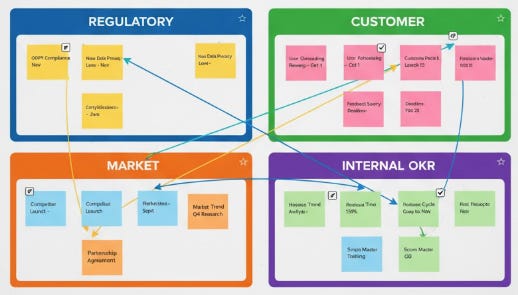
Capture answers visibly.
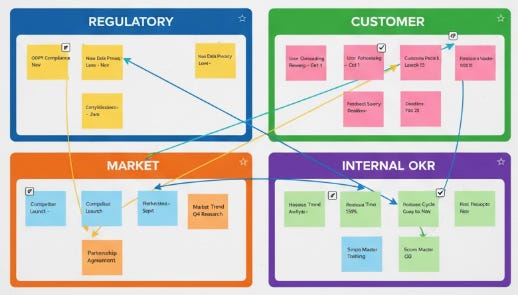
Create a small table in Excel -

This transparency often reveals the real pressure — and hidden flexibility.

Summarize, don’t argue.
At the end of the call, say: “Got it. So the real driver is the marketing event, and we can trade some features if needed.”
This line reframes you from “resistor” to “solution partner.”
Challenge I faced
When I first tried this, the VP’s response was blunt: “We don’t need another discussion. We just need this done.”
For a moment, I froze. I could feel the tension in the room — the unspoken thought that I was being “too process-heavy.”
I realised I had made a mistake: I was asking questions without connecting them to their pressure.
The next time, I opened with empathy instead of data. I said: “I completely understand why this date matters. Let me help you make sure we can hit it without last-minute surprises.”
That one sentence changed everything. The conversation turned collaborative instead of defensive.
It changes the tone instantly — from confrontation to collaboration.
Strategy 2: Translate Promised Dates into Forecasts
“When a date is handed down, your power lies in translating it into data.”
What to Do
Pull your team’s last 5 sprints’ average velocity.
Let’s say it’s 45 points per sprint.Estimate roughly (T-shirt sizing works).
Even if the stories aren’t perfect, get ballpark complexity from the team:Login Revamp → L
Dashboard → XL
Notifications → M
Convert them into rough story points to find total capacity needed (say, 220 points).
Create a simple Excel forecast:
Sprint 1–5 → 45 points each = 225 total → roughly 10 weeks.
Compare with promised date (March 15).
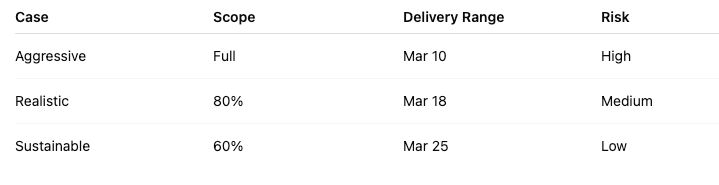
Highlight realistic completion range (March 10–25).
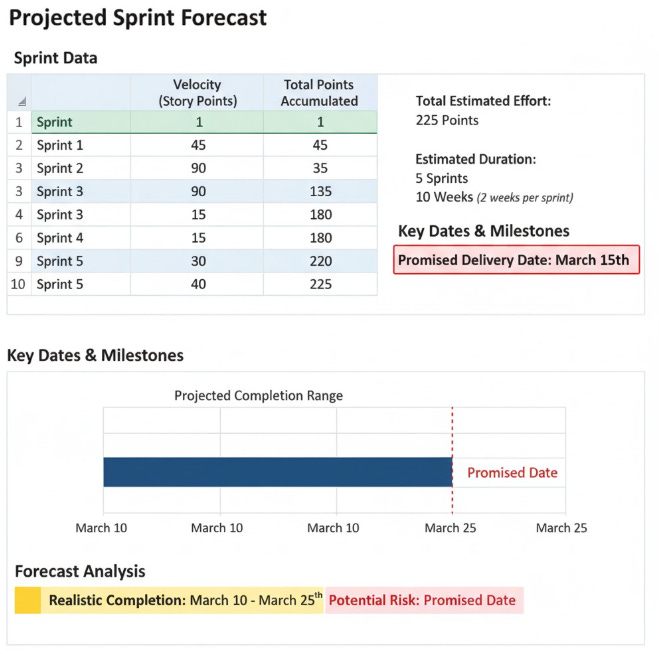
Present it calmly:
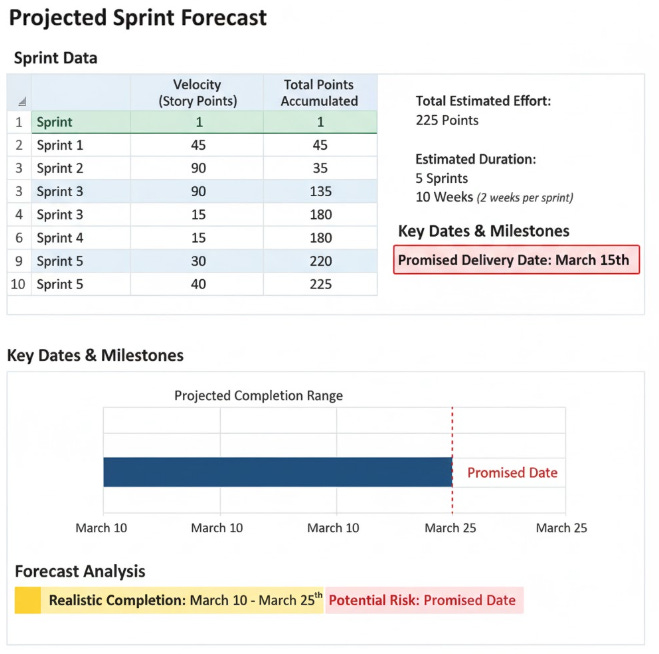
“Based on our historical velocity, March 10–25 looks feasible if we manage scope and dependencies smartly.”
Offer scenarios:
Challenge I faced
When I first showed a velocity-based forecast to leadership, they pushed back hard: “You’re overcomplicating this. Other teams are faster — why can’t yours be?”
I realised that throwing data alone didn’t work — they saw it as an excuse, not insight.
So, instead of presenting charts, I started telling a story with data.
I said: “Last time we rushed under a fixed date, we delivered on time — but spent the next Sprint fixing defects. Here’s what that looked like in rework hours.”
That small shift — data with a story — changed the narrative. Now they saw forecasting as protection, not resistance.
Strategy 3: Make Trade-offs Visible Without Politics
“Transparency beats negotiation. Show the options; let them choose.”
What to Do
In your next planning session, show 3 delivery paths:
Path 1: Deliver full scope → high stress, quality risk.
Path 2: Focus on core outcomes → fewer stories, same date.
Path 3: Add one Sprint → complete scope, stable pace.
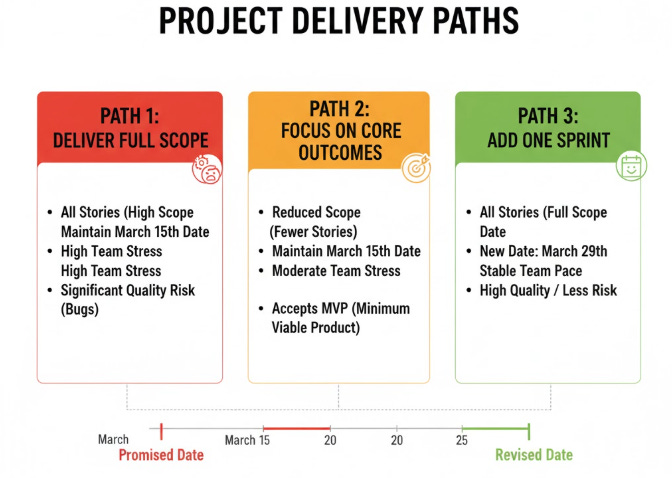
Frame it like this:
“Given March 15, here’s what’s possible. Which outcome matters most — time, scope, or stability?”
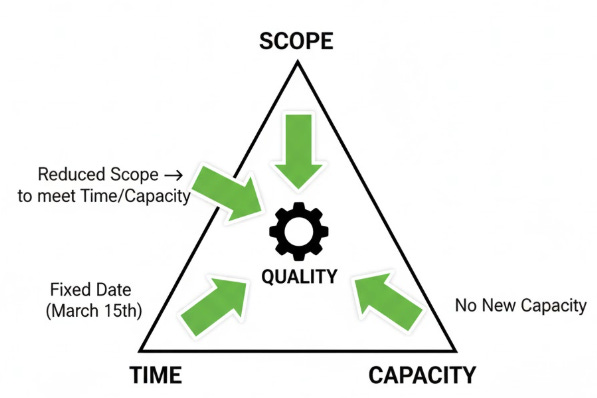
Use the Agile Triangle visual (Scope–Time–Capacity).
Label each side clearly. Draw attention to the fixed corners.
Document the decision.
Don’t leave it verbal. Create a short “Decision Note” with what trade-off was agreed and who approved.
Challenge I faced
I remember a meeting where I presented three options — full scope, reduced scope, or delayed delivery.
The stakeholder smiled politely and said: “We’ll take all three.”
Everyone laughed, but I knew the message was serious — they wanted everything. I walked out of that call realising something crucial: people don’t reject trade-offs; they reject uncertainty.
The next time, I visualised the trade-off.
I drew a triangle on Miro and said: “You can fix any two — scope, time, or capacity — but not all three. Which two would you prefer?”
It took 30 seconds of silence before they said, “Alright, reduce scope slightly.”
That was the first time I saw leadership visibly understand the cost of “yes.”
Strategy 4: Bring Data to Emotionally Charged Conversations
“Data grounds emotion — but empathy opens the door.”
What to Do
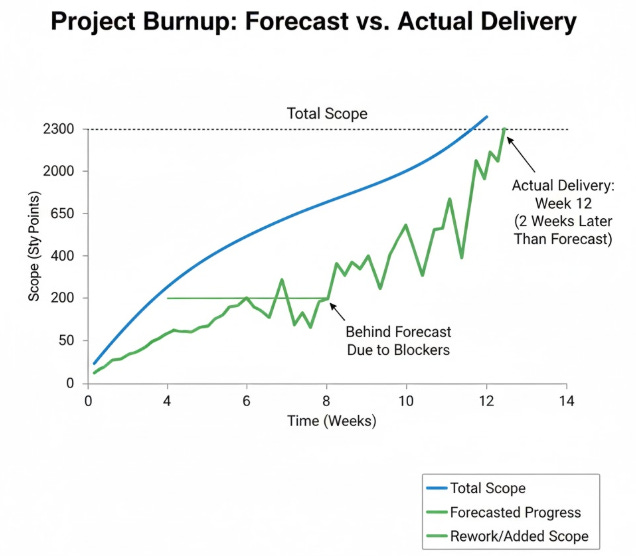
Collect simple but powerful evidence:
Velocity Chart (past 5 sprints)
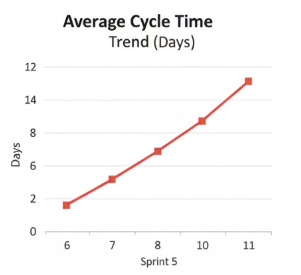
Cycle Time Trend (how long work items take)
Defect Leakage Rate (impact of rushing)
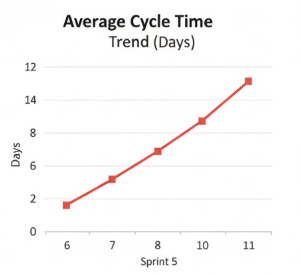
Share these in storytelling format:
“When we compressed scope last Sprint, our rework rose by 30%.”
“When we reduced load, we met every Sprint Goal.”
Use visuals instead of explanations.
One clean graph is better than 10 minutes of talk.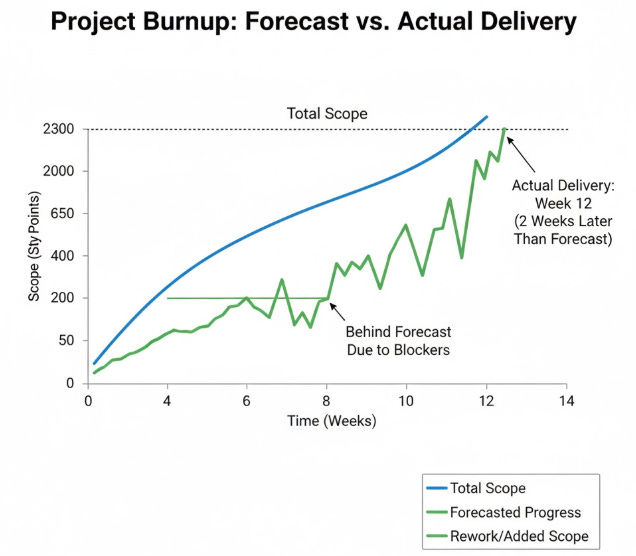
Offer data as a shared discovery, not a lecture: “Can we look at this together to see what’s feasible by March 15?”
Challenge I faced
There was a moment when I presented defect data to justify extending a release.
One leader immediately snapped: “So you’re saying the team can’t handle pressure?”
It hit me that data — no matter how logical — sounds defensive if your tone doesn’t show empathy.
The next time, I opened with this line: “I know this release matters deeply. The team’s fully committed. Here’s how we can hit the goal without sacrificing quality.”
Then I showed the defect chart. This time, the tone of the room changed — people leaned in instead of pushing back.
That’s when I realised the formula: Empathy first, evidence next.
Strategy 5: Build a “Pre-Commitment” Ritual
“If a bad pattern repeats, systematize the prevention.”
What to Do
Propose a 30-min “Pre-Commitment Huddle” before leadership communicates any new delivery date.
Agenda:PO presents preliminary plan.
Team reviews estimation readiness.
Scrum Master highlights known risks.
Leadership confirms timeline after visibility.
Create a RACI Matrix:
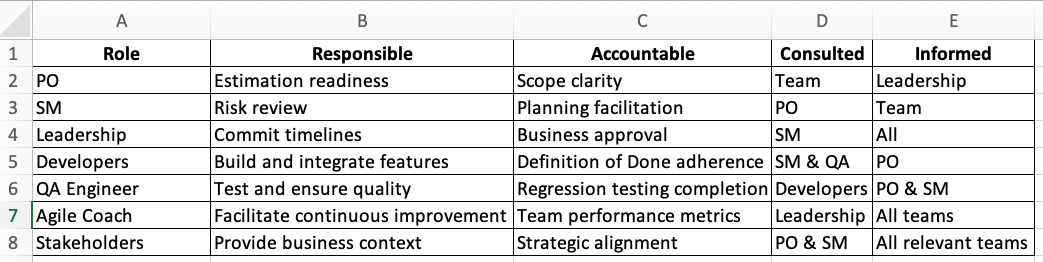
Keep it lightweight.
Make it a habit, not a bureaucracy.Share a simple visual summary after each session:
“We validated 5 Epics → 3 are estimation-ready → 2 need refinement.”
Challenge I faced
When I first suggested a pre-commitment huddle, one senior manager said: “We don’t need another ceremony slowing us down.”
And honestly, part of me agreed — we already had so many meetings.
But I realised this wasn’t a meeting problem — it was a visibility problem.
So I reframed it: “This isn’t another meeting. It’s 30 minutes that will save 3 weeks of rework.”
Then, after the first cycle, when we avoided a huge last-minute change, I sent a short summary email: “We just saved 2 weeks of delay because we validated scope early — thanks to the pre-commitment huddle.”
The next time, the same manager said, “Let’s keep this as a standard step.”
That’s how the ritual stuck.
Try This Tomorrow
In your next conversation with leadership, ask this single question:
“If we need to hit this date, what’s the minimum outcome that still delivers value?”
You’ll be surprised how quickly the conversation moves from “deadlines” to “business impact.”
Leaders promise dates to show confidence.
Scrum Masters and Product Owners build credibility by showing clarity.
One wins short-term trust.
The other sustains it.
Choose clarity — every time.
👥 Turn Deadline Pressure into Predictable Delivery — Practice It Live!
Want to experience how to respond when leadership commits to dates before the team even estimates — without sounding defensive or losing trust?
Join my Scrum Career Accelerator – Community of Practice.
We simulate the real pressure-cooker moments you face every Sprint:
Leadership promising timelines you didn’t commit to.
Teams unsure how to respond.
Stakeholders pushing for “certainty.”
You’ll learn exactly how to handle these situations — calmly, transparently, and with data — while protecting your team and maintaining leadership confidence.
🚀 Join us this Saturday.
Practice real-world conversations.
Get coached live.
Learn how to turn top-down pressure into collaborative planning.

🚀 Join us this Saturday. Practice real scenarios, get coached live, and build the confidence to lead your next refinement like a pro.
Master Every Interview Question on Remote Scrum Mastery!
Ever been in an interview — or a real project — where someone from leadership confidently said:
“We’ve already promised the client a release date.” …and you hadn’t even estimated the work yet?
Or maybe you’ve faced this question in an interview:
“What would you do if leadership sets delivery dates before the team even refines or estimates?”
Most Scrum Masters give the textbook reply —
“I’d remind them that estimation is a team activity.”
But when the interviewer digs deeper —
“Can you share a real example of how you handled that situation?” — many go silent.
Not because they don’t understand Scrum,
but because turning a top-down commitment into a collaborative forecast takes more than quoting the Scrum Guide.
It takes diplomacy, data, and courage to negotiate without conflict.
That’s exactly why I’ve created a Practical Interview & Coaching Guide on Handling Leadership Promises in Agile Delivery — built from real conversations I’ve had with executives, teams, and Product Owners caught in the same situation.
Inside this guide, you’ll find:
✅ 10 realistic interview questions about managing leadership expectations and premature commitments.
✅ Story-style answers showing how to use empathy, velocity data, and visual trade-offs to align on realistic forecasts.
✅ Scripts and frameworks you can use tomorrow — like the “Pre-Commitment Huddle” and “Forecast Alignment Canvas.”
This isn’t theory — it’s based on real war-room moments where I had to balance relationships, protect the team, and still deliver outcomes that leadership could trust.
If you’re preparing for Scrum Master or Agile Coach interviews,
or you’re tired of hearing deadlines before you’ve even refined the stories —
this guide will show you how to turn pressure into partnership.
📥 Download your free guide — “Turning Leadership Promises into Predictable Delivery” →
Start mastering the conversations that separate facilitators from true Agile leaders.
Why Subscribe
Each week, I share battle-tested strategies, messy lessons, and practical tools that help Scrum Masters, Product Owners, and change agents like you make sense of chaos — without sugar-coating it.
If you found this useful, subscribe.
This isn’t theory. It’s real work, made a little easier — one step at a time.
“Just because I understand it, does not mean everyone understands it. And just because I do not understand it, does not mean no one understands it.”

Anand Pandey
Thanks for reading Strategy For Success! Subscribe for free to receive new posts and support my work.