
The 3-second rule that wins interviews
Why filling the silence is costing Scrum Masters the offer — and a 3-second rule that fixes it.

A coaching client walked out of a final-round interview last week certain she’d nailed it. Strong answers. Good rapport. The hiring manager even smiled.
She didn’t get the offer.
When we replayed the recording together, I asked her to count something. Every time the interviewer paused — even for a second — how long did she wait before speaking?
Average gap: under half a second.
She wasn’t answering questions. She was racing them. And every time she filled a silence the interviewer hadn’t finished, she gave up the most senior thing she could have done in that room.
Senior people are comfortable with silence. Junior people fill it.
Watch any interview that goes well, and you’ll notice the same pattern. Same question, two different candidates:
Interviewer: “Tell me about a time you pushed back on a senior stakeholder.” Candidate A — answers in 0.5 seconds: “Yeah so there was this time…”
vs.
Interviewer: “Tell me about a time you pushed back on a senior stakeholder.” Candidate B — pauses 3 seconds, then: “There are two that come to mind. The one that taught me the most was…”
Same question. Same experience, possibly. Two completely different signals about how this person operates under pressure.
Candidate A is performing. Candidate B is thinking.
Hiring managers can tell the difference in the first 30 seconds.
The 3-second silence rule
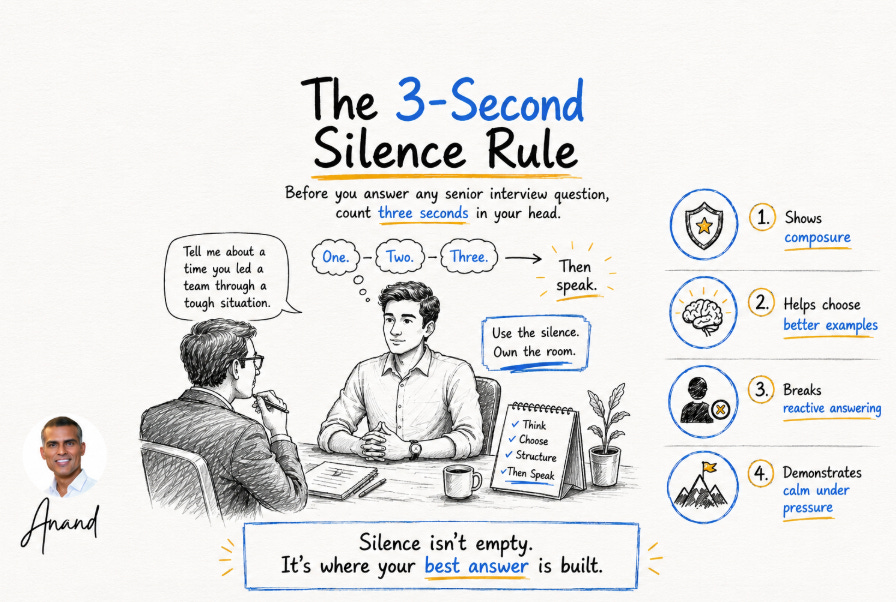
Before you answer any senior interview question, count three seconds in your head.
One. Two. Three. Then speak.
Three words. That’s the whole rule.
Three seconds feels like an eternity when you’re nervous. It feels normal to the interviewer. That gap is doing four things at once — and all of them are working in your favor:
It signals you take the question seriously
It gives you time to pick the best example, not the first one
It breaks the candidate’s reflex to please
It tells the room you can hold pressure without panicking
Most candidates can’t do this. They’ve trained themselves to be quick because they think quick = sharp. In senior interviews, the opposite is true. Quick = junior. Considered = senior.
If you can’t sit with three seconds of silence in front of an interviewer — that’s not an interview problem. That’s the signal.
If you want to practise this live — with feedback, in front of others — I run a Hot Seat session where one person sits in the chair and works through real interview pressure with the group. It’s free, it’s uncomfortable, and it’s the fastest way I know to get unstuck. Reply with “Hot Seat” and I’ll add you to the next one.
What’s the last interview answer you wish you’d taken three more seconds to give?
— Anand
This is a very good catch. I think I needed this, I do this often coz I don't like the silence. Amazing Anand, this 3 second rule is going to save me and make me a much better person now in interviews as well as in real life. Thank you so much. (Enlightened :D )