
The 5-Second Silence: Why Your Perfect Velocity Charts are Stalling Your Move to Senior Leadership
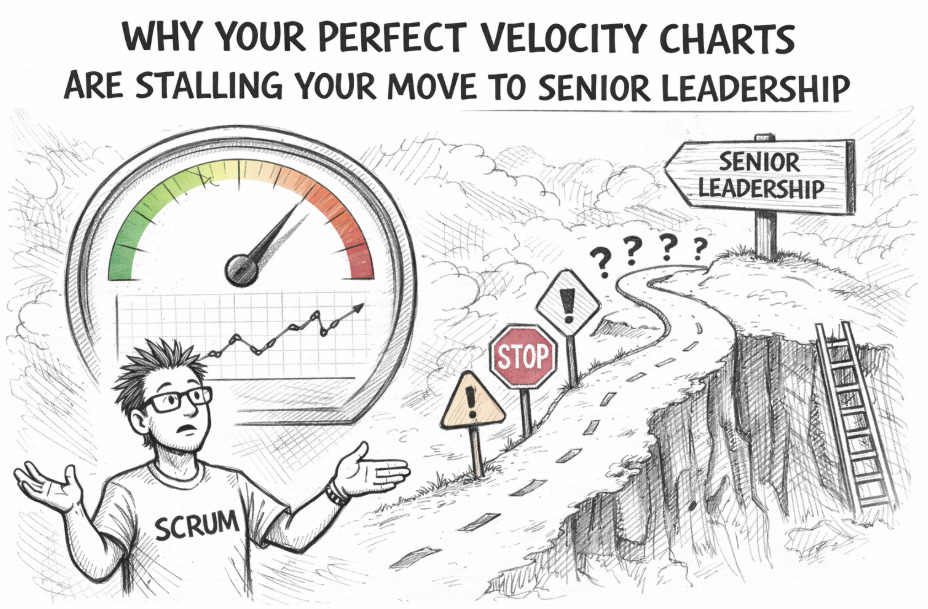
Reporting on "what happened" signals administration, not authority. If your dashboards are green but your career is stuck, you might be trapped in the Velocity Delusion.

Last quarter, a senior Scrum Master I was mentoring—let’s call him Amit—forwarded me a slide before his leadership review.
Amit is sharp, organized, and always prepared. The slide was clean:
12 sprints completed
Velocity up from 32 to 38
Predictability improved
All ceremonies on track
At the bottom, he’d added a confident line: “Delivery has stabilized.”
During the review, the VP nodded politely. Then she asked one question. “So… what should we be worried about next quarter?”
Amit hesitated. He scrolled back to the velocity chart. Then to the sprint count. Then to the burndown. Nothing there answered the question.
That pause lasted maybe five seconds. It felt much longer. This is where many careers quietly stall.
I’ve seen this pattern play out repeatedly in leadership rooms. Scrum Masters walk in armed with velocity trends and clean dashboards. They’ve done the work. They’ve tracked the numbers. And yet, the conversation moves on without them.
Reporting on what happened doesn’t signal leadership. It signals administration. Leaders don’t gather to admire activity. They gather to make decisions under uncertainty.
A week later, I saw the alternative. Another lead, Neeraj, had similar data, but he spoke differently. He said: “Velocity is steady, but it’s hiding a growing testing bottleneck. If we keep this pace, quality issues will surface close to the release window.”
The room slowed down. Someone asked, “How confident are you?” “Based on the last four sprints,” Neeraj replied, “there’s a real risk. We can absorb it now, or it will cost us later.”
No one asked how many sprints were completed.
This is the reframe that changes everything.
Velocity answers: “How much did we deliver?”
Leadership answers: “What decision does this data force us to make?”
When you only report velocity, you’re reporting movement—not meaning. That’s the difference between being busy and being trusted.
I’m curious—next time you look at your velocity chart, ask yourself: If I couldn’t show the numbers, what story would the trend tell me about our risks? Comment and tell me one “hidden” thing your current metrics are masking. I’d love to hear it.
This is also why interviews feel strange for many Scrum Masters. You explain how velocity improved. You sound capable. Then comes the feedback: “Good understanding of Agile. Not quite senior yet.”
They weren’t looking for a better metric. They were looking for a better translation.
One pattern I keep seeing is this:
The people who move forward don’t abandon metrics. They translate them into consequences.
Pay attention to your next conversation. Notice whether you’re being asked, “How are things going?” or “What do you think we should do?”
Those questions sit on opposite sides of the same data. Careers tend to follow the second one.
Velocity tells you how fast you’re moving.
Leadership starts when you explain where that speed is taking you—and what might break along the way.
Until then, you’re reporting. Not leading.
Ace Every Interview Question — With Real Answers That Work
If you’re preparing for Scrum Master, Agile Coach, or Product Owner interviews, this is your go-to prep pack. New set every week!
📥 Download your free Agile Interview Q&A Set here →
Why Subscribe
Each week, I share battle-tested strategies, messy lessons, and practical tools that help Scrum Masters, Product Owners, and change agents like you make sense of chaos — without sugar-coating it.
If you found this useful, subscribe.
Thanks for reading Strategy For Success! Subscribe for free to receive new posts and support my work.
This isn’t theory. It’s real work, made a little easier — one step at a time.
Thanks for reading Strategy For Success! Subscribe for free to receive new posts and support my work.
“Just because I understand it, does not mean everyone understands it. And just because I do not understand it, does not mean no one understands it.”

Anand Pandey