
The Harmony Tax: Why Being the “Easy” Scrum Master Slows Your Career
Why being the “easiest” person to work with is often a silent signal that you aren't ready for the next level.

A Product Director—let’s call him Vikram—once sat across from me at lunch, leaning back with a satisfied look on his face.
“I’ve finally found the perfect lead for that team,” he said. “Priya is incredible. She’s just so... easy to work with. She never pushes back, she keeps everyone happy, and there’s zero friction. I wish I had ten more of her.”
Vikram meant it as a glowing endorsement. But as I listened, I felt a familiar sense of dread for Priya’s career.
Six months later, my fears were confirmed. A high-stakes Product Owner role opened up—a role that required navigating intense stakeholder conflict and making brutal trade-offs.
I asked Vikram if he was considering Priya. He didn’t even hesitate. “Oh, no. Priya is great where she is. She’s a ‘stabilizer.’ For this new role, we need a ‘shaper’—someone who isn’t afraid to get their hands dirty in a disagreement.”
Priya had paid the Harmony Tax. And she didn’t even know she’d been billed.
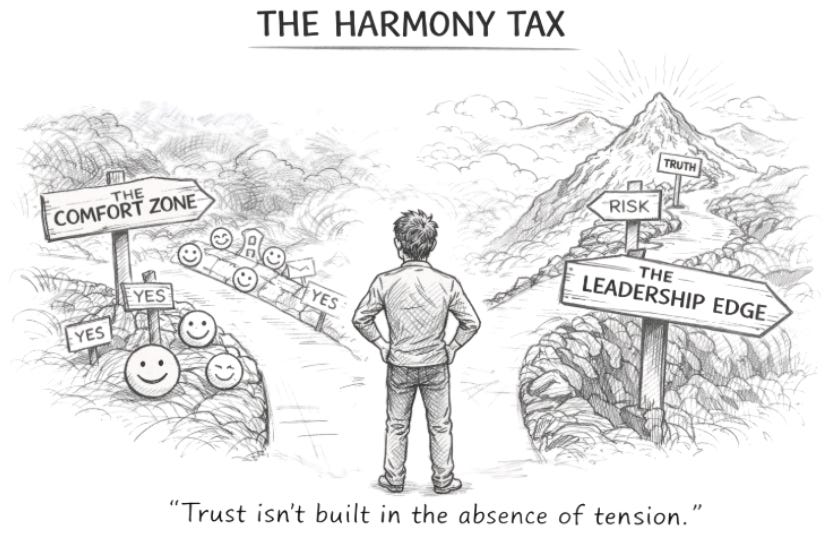
This is a pattern I see constantly with professionals in the 10–15 year bracket. You’ve spent a decade being the “reliable” one. You pride yourself on being low-maintenance. You think that by smoothing over every wrinkle, you’re showing leadership.
But in the rooms where decisions are made, “easy to work with” is often code for “doesn’t have a point of view.”
There is a silent calculation happening in leadership reviews:
The Harmonizer: Protects the “vibe” of the meeting.
The Leader: Protects the “truth” of the situation.
The first is pleasant. The second is indispensable.
I remember watching Priya in a roadmap session a few weeks after that lunch. The Product Director was suggesting a timeline that everyone in the room knew was impossible.
Priya smiled and said, “We’ll certainly do our best to align the team and see how we can make it work.”
Another Lead interrupted, “If we try to hit that date, we’ll have to cut the security audit. Are we prepared to take that brand risk?”
The room went cold for a second. It was uncomfortable. It was “high friction.”
But guess who the Product Director started looking at for the rest of the meeting? It wasn’t Priya. He started directing his questions to the person who was willing to ruin the “vibe” to save the product.
Leadership isn’t about the absence of tension; it’s about the mastery of tension.
If you spend your days optimizing for harmony, you are signaling that your personal comfort—and the comfort of those around you—is more important than the clarity the business needs. That is the definition of a mid-level manager.
Seniority requires the “teeth” to hold an uncomfortable truth without losing your composure.
Stop trying to be the “easy” one. Start being the one who is trusted to name the elephant in the room.
Being easy to work with gets you liked. Being willing to manage tension gets you promoted.
Those two things rarely happen on the same path.
I’m curious—when was the last time you let an unrealistic expectation slide just to keep a meeting “easy”? What did that silence cost your reputation?
Ace Every Interview Question — With Real Answers That Work
If you’re preparing for Scrum Master, Agile Coach, or Product Owner interviews, this is your go-to prep pack. New set every week!
📥 Download your free Agile Interview Q&A Set here →
Why Subscribe
Each week, I share battle-tested strategies, messy lessons, and practical tools that help Scrum Masters, Product Owners, and change agents like you make sense of chaos — without sugar-coating it.
If you found this useful, subscribe.
Thanks for reading Strategy For Success! Subscribe for free to receive new posts and support my work.
This isn’t theory. It’s real work, made a little easier — one step at a time.
“Just because I understand it, does not mean everyone understands it. And just because I do not understand it, does not mean no one understands it.”

Anand Pandey