
The Interview Trap: Why speaking more is costing you the job.

A candidate told me something recently that I hear all the time.
“I think I over-explained,” he said. “I answered everything… but I could feel them losing interest.”
He had good experience. Solid examples.
But somewhere along the way, his answers got longer. And their attention got shorter.
This is the trap.
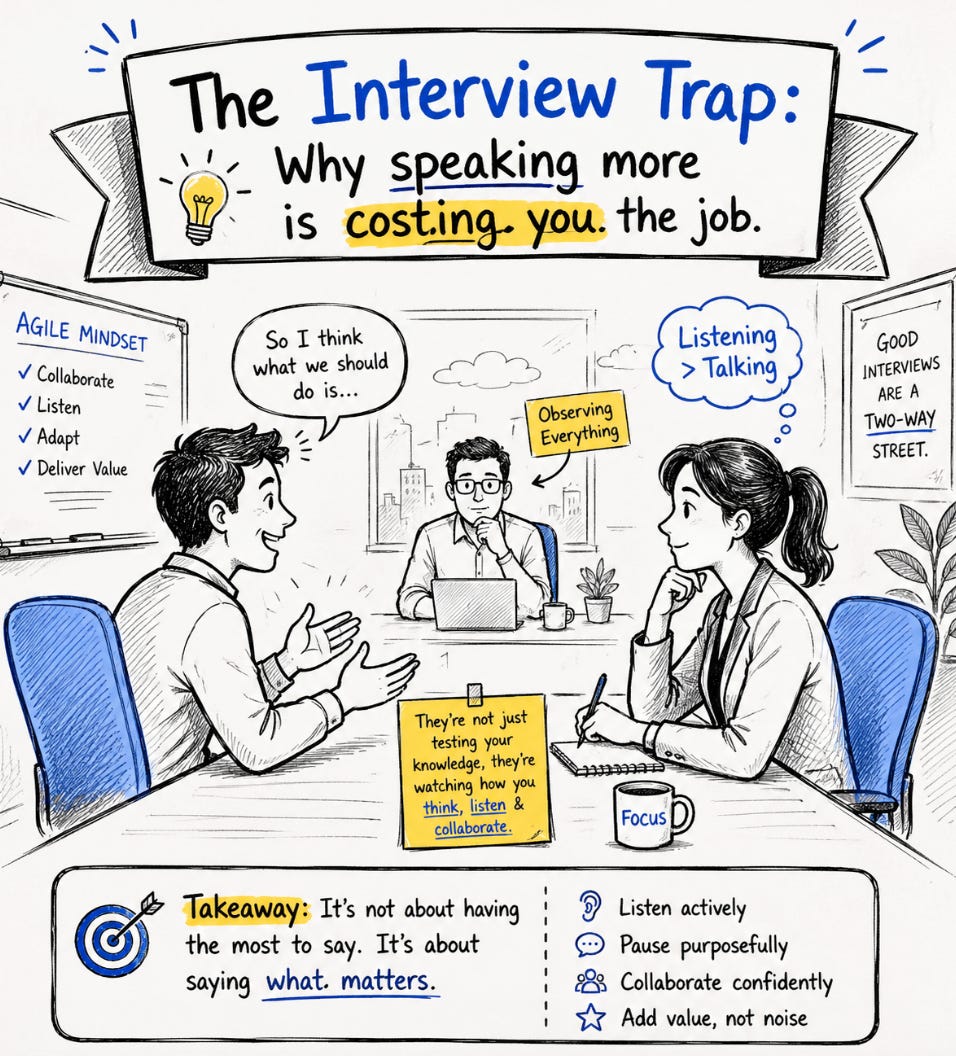
When we are desperate to prove our experience, we assume that
Quantity of Details = Quality of Experience.
It doesn’t.
In interviews, amateurs explain the process. Experts explain the impact.
If you want to stop rambling and start sounding like a leader, make these 4 shifts.
Shift 1: Give me the Bottom Line, not the Background
When you start with context, the interviewer is waiting for the punchline. Don’t make them wait.
Amateur: “Let me give you some background. Last year, our team was structured in a way where testing was separate...” (Yawn)
Expert: “We were about to miss our Sprint Goal because testing was a bottleneck. Here is how we fixed it.” (I’m listening)
Actionable Tip: The B.L.U.F. Method (Bottom Line Up Front). Before answering, ask yourself: What is the one thing they must remember? Make that your very first sentence. Let them ask for the background if they need it.
Shift 2: Highlight the Decision, not the Activity
Anyone can facilitate a meeting. Anyone can update a board. Activity is cheap. Decisions are valuable.
Stop listing your daily chores. Start highlighting the hard choices.
Amateur: “I facilitated the planning session, aligned everyone, and tracked our progress.” (You sound like an administrator).
Expert: “We had to choose between hitting the release date or protecting our quality standards. We chose to delay. Here is how I managed the stakeholder fallout.” (You sound like a problem solver).
Actionable Tip: The “X over Y” Framework. For every story you tell, identify the trade-off. What did you influence the team to choose, and why? Lead with the decision.
Shift 3: Drop the Hook and Pause
The biggest mistake nervous candidates make? They keep talking to fill the silence.
“Also...” “One more thing...” “Just to add...”
Stop. Deliver a clear answer, and then physically pause.
Actionable Tip: The 60-Second Rule. If you are speaking for more than 60 seconds without a break, you are over-explaining. End your thought. Let them ask: “Oh, that’s interesting. What happened next?” Silence isn’t failure; it’s the space where a monologue turns into a conversation.
Shift 4: Translate Actions Into Outcomes
Never end a story with: “So yeah, that’s what we did.” It leaves the interviewer guessing if your actions actually mattered.
Amateur: “So we changed how we did our Daily Scrums.”
Expert: “As a result, we improved predictability and avoided a rushed, buggy release.”
Actionable Tip: The “So What?” Test. Every time you finish explaining an action, ask yourself: So what? What changed because of this? Your final sentence should always answer that question.
The Bottom Line
When you walk into your next interview, remember this:
The interviewer isn’t looking for a human textbook. They aren’t hiring a list of tasks.
When you explain every tiny detail, you sound like someone who just did the work. When you highlight what mattered, you sound like the person who led the change.
Stop trying to prove you were in the room. Start showing the difference you made.
Ace Every Interview Question — With Real Answers That Work
If you’re preparing for Scrum Master, Agile Coach, or Product Owner interviews, this is your go-to prep pack. New set every week!
📥 Download your free Agile Interview Q&A Set here →
Why Subscribe
Each week, I share battle-tested strategies, messy lessons, and practical tools that help Scrum Masters, Product Owners, and change agents like you make sense of chaos — without sugar-coating it.
If you found this useful, subscribe.
This isn’t theory. It’s real work, made a little easier — one step at a time.
“Just because I understand it, does not mean everyone understands it. And just because I do not understand it, does not mean no one understands it.”

Anand Pandey