
Why AI Isn’t Replacing Scrum Masters — But the Job Market Is

Over the last year, one question has followed me everywhere.
After workshops. Inside coaching calls. Late at night on WhatsApp.
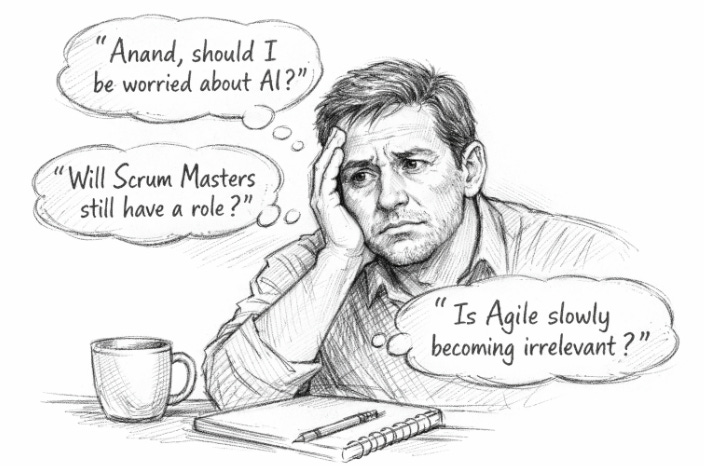
“Anand, should I be worried about AI?”
“Will Scrum Masters still have a role?”
“Is Agile slowly becoming irrelevant?”
I understand where this fear comes from.
People are losing jobs. Hiring has slowed. Roles are fewer.
And suddenly AI is doing things that look like parts of our job.
But after working closely with many Scrum Masters navigating interviews, layoffs, internal role changes, and stalled careers, I’ve come to a very clear conclusion:
AI is not replacing Scrum Masters. The job market is filtering them.
And that difference is subtle — but career-defining.
The comforting stories we tell ourselves about AI
Most conversations about AI and Agile careers fall into one of two buckets:
Bucket 1:
“AI will replace Scrum Masters. We’re doomed.”
Bucket 2:
“AI doesn’t matter. Agile is about people.”
Both stories are emotionally convenient.
Both help us avoid a harder truth.
What I’m actually seeing on the ground is quieter and more uncomfortable:
The role still exists
But tolerance for average impact has collapsed
And the market is no longer patient
AI didn’t create this shift.
It simply accelerated it.
What actually changed (and what didn’t)
Let’s be clear.
Scrum Masters are not being replaced by tools.
What is being replaced is a certain version of the role — one that was already fragile.
A few years ago, many Scrum Master roles quietly revolved around:
Running ceremonies smoothly
Removing blockers reactively
Being the “nice Agile person”
Protecting the team from discomfort
In many organisations, that was enough.
Today, when I sit with hiring managers or review interview feedback, I hear very different questions:
“Can this person reduce delivery risk?”
“Can they influence without authority?”
“Can they handle tension with senior stakeholders?”
“Can they make trade-offs explicit instead of absorbing pressure?”
“Can they operate when there is no clear playbook?”
Same title.
Radically different expectations.
The pattern I’ve seen too many times
At this point in my coaching work, I can often predict interview outcomes within the first few answers.
Not because candidates are weak.
But because the signals are familiar.
Many capable Scrum Masters describe their work like this:
“I facilitated…”
“I supported…”
“I ensured alignment…”
It sounds collaborative.
It also sounds invisible.
The job market has quietly stopped rewarding effort and activity.
It is rewarding judgement and clarity.
And this is where many good people get filtered out.
What hiring managers are really listening for
Most interview rejections today have nothing to do with Scrum knowledge.
They happen because interviewers are silently asking questions like:
Can I trust this person when things get messy?
Will they surface risks early or absorb them quietly?
Will they protect the system or just keep people comfortable?
Can they challenge decisions without becoming defensive?
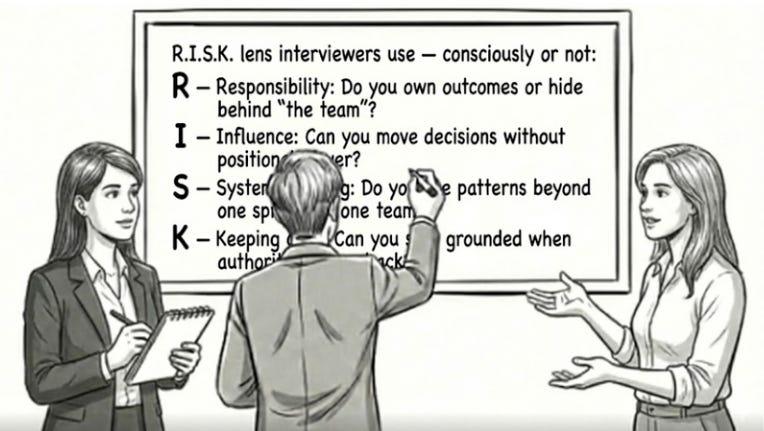
I often describe this to candidates as the R.I.S.K. lens interviewers use — consciously or not:
R — Responsibility: Do you own outcomes or hide behind “the team”?
I — Influence: Can you move decisions without positional power?
S — System thinking: Do you see patterns beyond one sprint or one team?
K — Keeping calm: Can you stay grounded when authority pushes back?
AI can generate reports.
AI can summarise meetings.It cannot pass this test.
How I coach Scrum Masters to survive — and stand out — in this market
I don’t start with AI tools.
I don’t start with resumes.
I start by changing how people see their own value.
Because most Scrum Masters already have the experience — they just don’t recognise it in a market-relevant way.
From “what I did” to “what changed”
Most people explain their work as a list of activities.
That’s understandable. It’s how job descriptions are written.
But interviews — and promotions — are decided on impact.
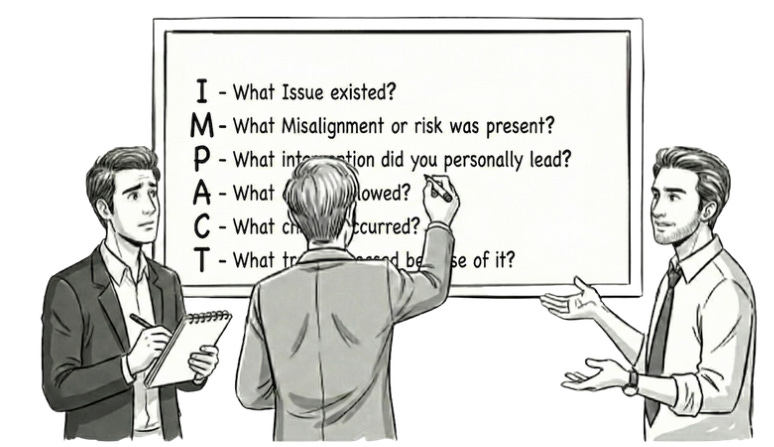
So I coach Scrum Masters to structure their stories around something I call IMPACT:
What Issue existed?
What Misalignment or risk was present?
What intervention did you personally lead?
What action followed?
What change occurred?
What trust increased because of it?
Same experience.
Completely different signal.
This alone often changes how “senior” someone sounds.
Developing skills AI cannot copy
AI is excellent at execution support.
Which means the human side of the role is now under a microscope.
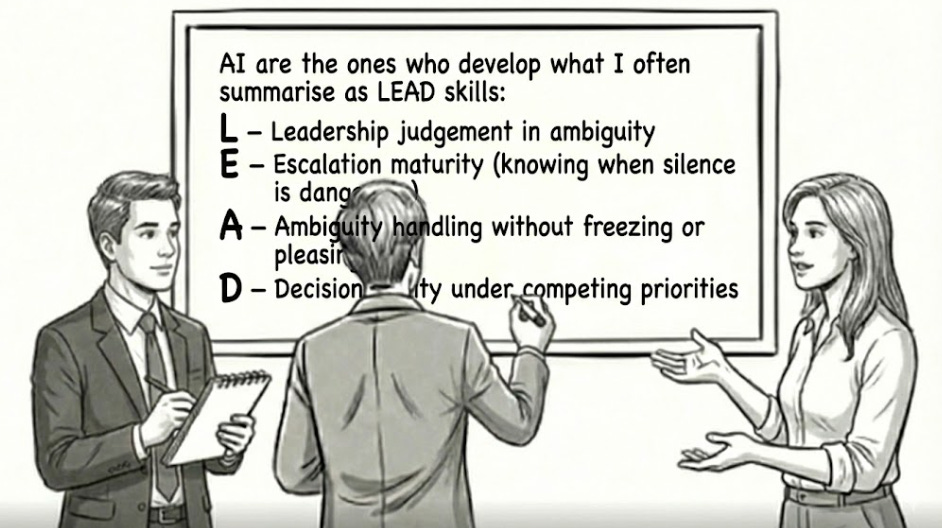
The Scrum Masters who stop worrying about AI are the ones who develop what I often summarise as LEAD skills:
Leadership judgement in ambiguity
Escalation maturity (knowing when silence is dangerous)
Ambiguity handling without freezing or pleasing
Decision clarity under competing priorities
These skills don’t show up in certifications.
But they decide careers.
Learning to protect the system, not just the team
This is one of the hardest shifts.
Earlier in Agile adoption, protecting the team was celebrated.
Today, leadership expects Scrum Masters to also protect:
delivery reliability
quality
learning loops
long-term outcomes
Even when it means:
slowing things down
saying no
disappointing stakeholders
One question I regularly coach people to answer is:
“What did you choose not to do — and why?”
That answer reveals leadership maturity instantly.
Why AI actually makes this more important
As AI takes over:
reporting
documentation
summaries
routine facilitation
The Scrum Master role becomes less about doing and more about thinking.
The market has already adjusted to this reality.
Many careers haven’t.
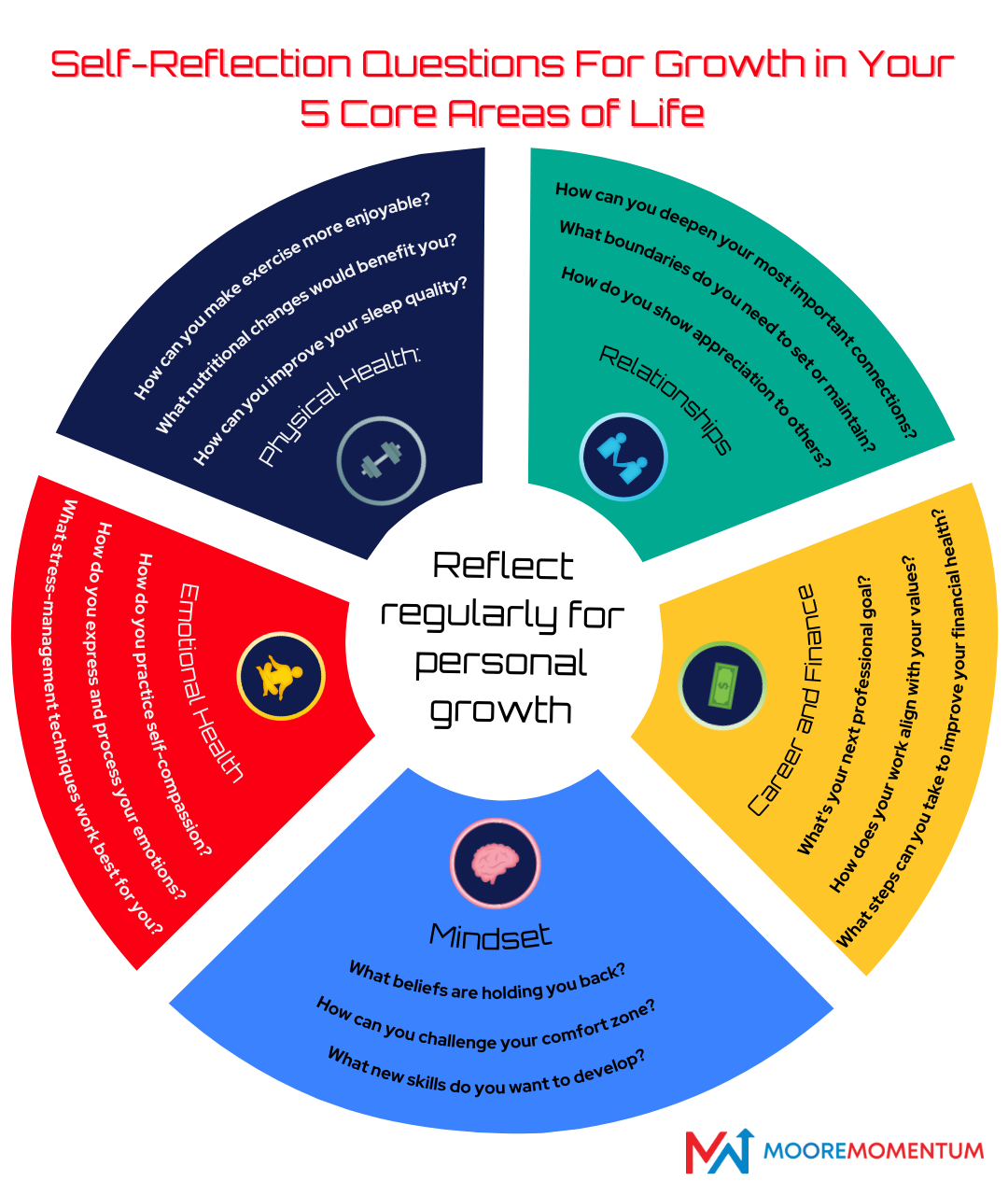
Self Reflection Time!
Pause here and be honest.
If most of your impact stories still start with:
“I facilitated…”
“I coordinated…”
“I supported…”
Then AI is not your biggest threat. AI isn’t replacing Scrum Masters.
Being forgettable is.
And the current job market is brutally efficient at filtering that out.
The job market is no longer protecting people who rely on activity instead of judgement.
Those who learn to think clearly, influence calmly, and lead beyond frameworks
won’t just survive this shift.
They’ll become more valuable because of it.
Ask yourself this — without rushing to answer:
If AI handled my meetings and reports tomorrow, what part of my value would still clearly remain?
That answer tells you exactly where your career growth lies.
Join our Community — Practice It Live!
If you want to practice these techniques live, join my next AI & Agile Career Accelerator - Community of Practice.
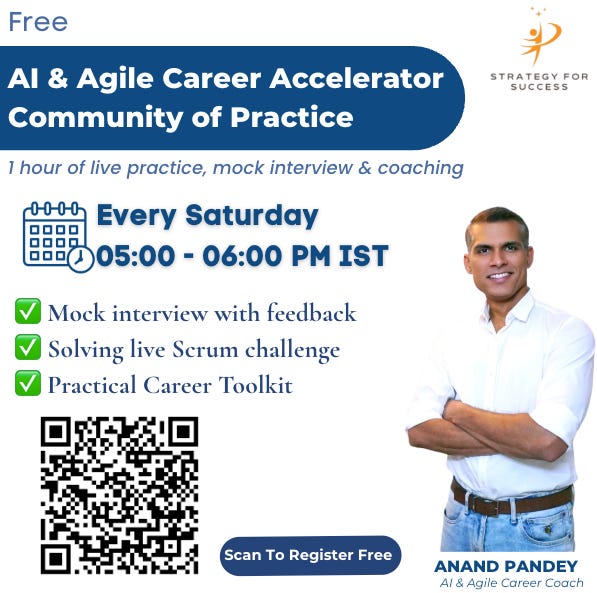
🚀 Join us this Saturday. Practice real scenarios, get coached live, and build the confidence to lead your next refinement like a pro.
Ace Every Interview Question — With Real Answers That Work
If you’re preparing for Scrum Master, Agile Coach, or Product Owner interviews, this is your go-to prep pack. New set every week!
📥 Download your free Agile Interview Q&A Set here →
Why Subscribe
Each week, I share battle-tested strategies, messy lessons, and practical tools that help Scrum Masters, Product Owners, and change agents like you make sense of chaos — without sugar-coating it.
If you found this useful, subscribe.
Thanks for reading Strategy For Success! Subscribe for free to receive new posts and support my work.
This isn’t theory. It’s real work, made a little easier — one step at a time.
Thanks for reading Strategy For Success! Subscribe for free to receive new posts and support my work.
“Just because I understand it, does not mean everyone understands it. And just because I do not understand it, does not mean no one understands it.”

Anand Pandey